Skip to content
Phonix logo brand : Phonix

Smart Charger

  • Home
  • ChargerExpand
    • Lead-acid Battery ChargerExpand
      • 14.4V Lead-acid Battery Charger for 12V Battery Packs
      • 29.2V Lead-acid Battery Charger for 24V Battery Packs
      • 43.8V Lead-acid Battery Charger for 36V Battery Packs
      • 57.6V Lead-acid Battery Charger for 48V Battery Packs
      • 72V Lead-acid Battery Charger for 60V Battery Packs
      • 86.4V Lead-acid Battery Charger for 72V Battery Packs
    • Li-ion Battery ChargerExpand
      • 4.2V Charger for 1S 3.7V Battery
      • 8.4V Charger for 2S 7.4V Battery
      • 12.6V Charger for 3S 11.1V Battery
      • 16.8V Charger for 4S 14.8V Battery
      • 21V Charger for 5S 18.5V Battery
      • 25.2V Charger for 6S 22.2V Battery
      • 29.4V Charger for 7S 25.9V Battery
      • 33.6V Charger for 8S 29.6V Battery
      • 37.8V Charger for 9S 33.3V Li-ion Battery
      • 42V Charger for 10S 37V Battery
      • 46.2V Charger for 11S 40.7V Battery
      • 50.4V Charger 12S 44.4V Battery
      • 54.6V Charger for 13S 48V Battery
      • 58.8V Charger for 14S 51.8V Battery
      • 63V Charger For 15S 55.5V Battery
      • 67.2V Charger For 16S 59.2V Battery
      • 71.4V Charger For 17S 62.9V Battery
      • 75.6V Charger for 18S 66.6V Battery
      • 84V Charger for 20S 74V Battery
    • LiFePO₄ Battery ChargerExpand
      • 3.65V LiFePO₄ Battery Charger (1S 3.2V LFP Cells)
      • 7.3V LiFePO₄ Battery Charger (2S 6.4V LFP Packs)
      • 11V LiFePO₄ Battery Charger (3S 9.6V LFP Packs)
      • 14.6V LiFePO₄ Battery Charger (4S 12.8V LFP Packs)
      • 18.25V LiFePO₄ Battery Charger (5S 16V LFP Packs)
      • 21.9V LiFePO₄ Battery Charger (6S 19.2V LFP Packs)
      • 25.55V LiFePO₄ Battery Charger (7S 22.4V LFP Packs)
      • 29.2V LiFePO₄ Battery Charger (8S 25.6V LFP Packs)
      • 33.3V LiFePO₄ Battery Charger (9S 28.8V LFP Packs)
      • 36.5V LiFePO₄ Battery Charger (10S 32V LFP Packs)
      • 40.15V LiFePO₄ Battery Charger (11S 35.2V LFP Packs)
      • 43.8V LiFePO₄ Battery Charger (12S 38.4V LFP Packs)
      • 47.45V LiFePO₄ Battery Charger (13S 41.6V LFP Packs)
      • 51.1V LiFePO₄ Battery Charger (14S 44.8V LFP Packs)
      • 54.8V LiFePO₄ Battery Charger (15S 48V LFP Packs)
      • 58.4V LiFePO₄ Battery Charger (16S 51.2V LFP Packs)
      • 62.05V LiFePO₄ Battery Charger (17S 54.4V LFP Packs)
      • 65.7V LiFePO₄ Battery Charger (18S 57.6V LFP Packs)
      • 69.35V LiFePO₄ Battery Charger (19S 60.8V LFP Packs)
      • 73V LiFePO₄ Battery Charger (for 20S 64V LFP Packs)
    • Ni-MH battery chargers
    • PD Fast Charger
    • AC-DC Power Adapter
  • BMSExpand
    • Lithium Battery BMS
    • LiFePO4 Battery BMS
    • Lead Acid Battery BMS
    • NiMH Battery BMS
  • CustomExpand
    • Customization Service
    • Charging System Design
    • Custom Charger Development
    • ODM / OEM Implementation
  • ResourcesExpand
    • Smart Charging Systems
    • Safe Charging Architecture
    • Extreme Environment Charging
    • Energy & Solar Charging
    • Integrated Charging Solutions
  • Contact
Phonix logo brand : Phonix
Smart Charger

Energy & Solar Charging

Home / Energy & Solar Charging

Energy & Solar Charging

Energy & Solar Charging describes industrial battery charging systems that integrate photovoltaic input, hybrid AC sources, intelligent MPPT control, and adaptive firmware into a unified power management architecture.

Unlike conventional AC chargers designed for stable grid conditions, solar-integrated charging platforms must operate under fluctuating voltage, variable irradiance, and dynamic load behavior. System stability depends on coordinated control between energy input, battery chemistry, environmental conditions, and embedded firmware logic.

Phonix develops these systems as a smart charger ODM and OEM charger factory focused on industrial and renewable charging platforms, combining hardware design, firmware control, and scalable manufacturing under a single engineering framework.

What Differentiates Solar Charging from Conventional AC Charging

A conventional charger assumes predictable input voltage and continuous power availability. Solar charging does not. Photovoltaic panels generate variable output influenced by sunlight intensity, panel temperature, shading conditions, and time of day.

As a result, energy & solar charging systems require:

  • Wide input voltage tolerance
  • Real-time Maximum Power Point Tracking (MPPT)
  • Dynamic current modulation
  • Battery-type adaptive charging curves
  • Seamless switching between solar and grid sources

These capabilities extend the adaptive control principles described in Smart Charging Systems, where firmware intelligence becomes central to charging stability.

[Insert Diagram: Solar Panel → MPPT → DC Bus → Battery Control Loop]

MPPT Integration and Battery Compatibility

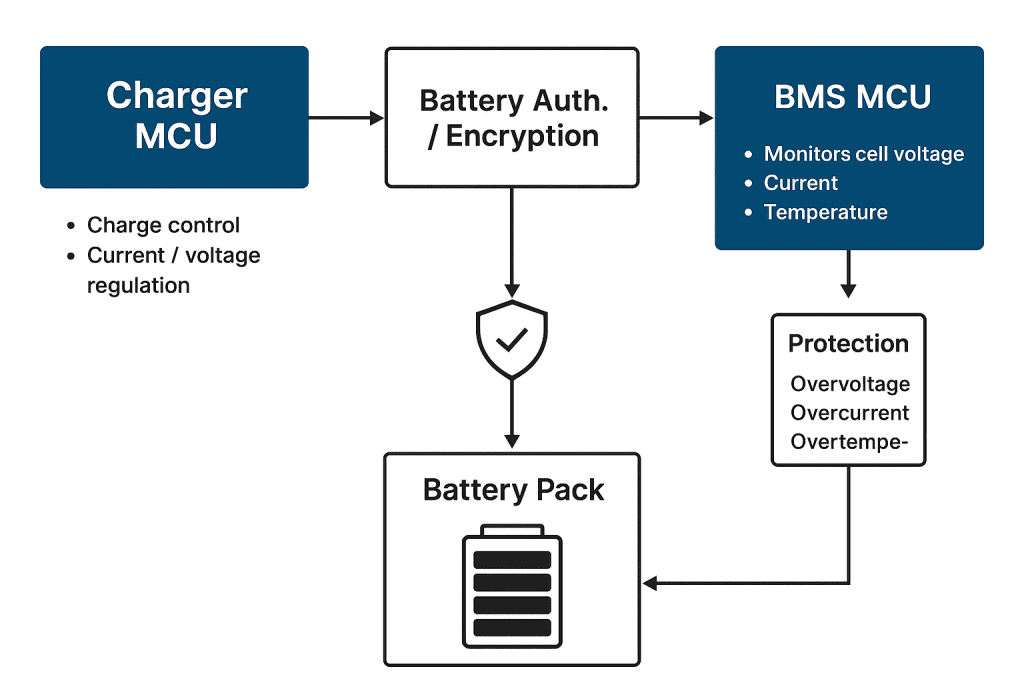
MPPT (Maximum Power Point Tracking) ensures photovoltaic panels operate at optimal efficiency. However, MPPT must not operate independently of battery safety logic. Charging current must align with battery chemistry limits, temperature state, and state-of-charge thresholds.

In industrial deployments, MPPT control is embedded directly into the charger’s firmware architecture rather than implemented as a standalone external controller. This integration allows:

  • Coordinated voltage regulation
  • Temperature-compensated charging curves
  • Closed-loop BMS communication
  • Fail-safe fallback under unstable irradiance

Protection logic remains aligned with the principles defined in Safe Charging Architecture, ensuring renewable input does not bypass safety thresholds.

Hybrid AC + Solar Energy Management

Many industrial applications require hybrid energy systems. Solar energy supplements grid input, while AC serves as backup during low irradiance periods. The charger must determine source prioritization without causing instability or reverse current flow.

Engineering requirements include:

  • Automatic source selection algorithms
  • Load balancing under partial generation
  • Reverse current prevention circuitry
  • Energy efficiency optimization at low solar yield
  • Grid synchronization control

Hybrid systems are especially critical in outdoor and remote environments where solar charging intersects with environmental stress factors discussed in Extreme Environment Charging.
phonix smart charger charter
phonix smart charger

Off-Grid Industrial Deployment

In off-grid infrastructure, agricultural equipment, remote monitoring stations, and mobile energy systems, charging platforms must function without guaranteed grid stability. Energy input variability becomes a structural design constraint rather than an exception.

Robust off-grid charging design incorporates:

  • State-of-charge predictive control
  • Battery storage buffer coordination
  • Thermal derating under outdoor conditions
  • Environmental enclosure protection
  • Long-term reliability validation

System architecture must treat energy generation, storage, and load demand as interconnected variables rather than isolated modules.

When a Custom Smart Charger Is Required

Standard solar chargers are often insufficient for industrial battery platforms requiring CAN communication, lithium-ion chemistry control, or multi-stage safety validation. In these cases, a custom smart charger is required to integrate:

  • Application-specific voltage profiles
  • Industrial communication protocols
  • Renewable input management
  • Environmental sealing requirements
  • Certification alignment (CE, UL, regional standards)

Custom development ensures renewable charging does not compromise battery longevity, safety margins, or regulatory compliance.

Engineering and Manufacturing Integration

Energy & solar charging platforms must scale from prototype validation to industrial deployment. Component derating, thermal modeling, enclosure durability, and firmware validation must remain consistent during volume production.

As an OEM charger factory, Phonix integrates product design, testing validation, and supply chain control to maintain reliability consistency from engineering sample to mass production.

For applications requiring multi-domain integration across energy input, intelligent control, environmental durability, and safety logic, see Integrated Charging Solutions.

Energy & Solar Charging as a System Architecture

Energy & Solar Charging is not defined by photovoltaic input alone. It represents a coordinated charging architecture integrating renewable energy management, adaptive firmware, battery safety control, environmental resilience, and scalable industrial manufacturing.

Through structured smart charger ODM development and custom smart charger engineering workflows, renewable charging platforms can be deployed reliably across industrial, infrastructure, agricultural, and mobile energy applications.

Return to Homepage

Global Markets

USA
Canada
Mexico

Germany
United Kingdom
France
Italy

Australia
New Zealand

Brazil
Chile
Argentina

China
Japan
South Korea
India

Singapore
Malaysia
Thailand
Philippines

UAE
Saudi Arabia
Qatar

South Africa
Egypt
Kenya

RESOURCES

  • ABOUT
  • BLOG
  • FAQ
  • PRIVACY

SOCIALS

  • Facebook
  • Linkedin
  • Youtube
  • X

© 2026 Smart Charger

Inquiry Now
Contact form
  • Home
  • Charger
    • Lead-acid Battery Charger
      • 14.4V Lead-acid Battery Charger for 12V Battery Packs
      • 29.2V Lead-acid Battery Charger for 24V Battery Packs
      • 43.8V Lead-acid Battery Charger for 36V Battery Packs
      • 57.6V Lead-acid Battery Charger for 48V Battery Packs
      • 72V Lead-acid Battery Charger for 60V Battery Packs
      • 86.4V Lead-acid Battery Charger for 72V Battery Packs
    • Li-ion Battery Charger
      • 4.2V Charger for 1S 3.7V Battery
      • 8.4V Charger for 2S 7.4V Battery
      • 12.6V Charger for 3S 11.1V Battery
      • 16.8V Charger for 4S 14.8V Battery
      • 21V Charger for 5S 18.5V Battery
      • 25.2V Charger for 6S 22.2V Battery
      • 29.4V Charger for 7S 25.9V Battery
      • 33.6V Charger for 8S 29.6V Battery
      • 37.8V Charger for 9S 33.3V Li-ion Battery
      • 42V Charger for 10S 37V Battery
      • 46.2V Charger for 11S 40.7V Battery
      • 50.4V Charger 12S 44.4V Battery
      • 54.6V Charger for 13S 48V Battery
      • 58.8V Charger for 14S 51.8V Battery
      • 63V Charger For 15S 55.5V Battery
      • 67.2V Charger For 16S 59.2V Battery
      • 71.4V Charger For 17S 62.9V Battery
      • 75.6V Charger for 18S 66.6V Battery
      • 84V Charger for 20S 74V Battery
    • LiFePO₄ Battery Charger
      • 3.65V LiFePO₄ Battery Charger (1S 3.2V LFP Cells)
      • 7.3V LiFePO₄ Battery Charger (2S 6.4V LFP Packs)
      • 11V LiFePO₄ Battery Charger (3S 9.6V LFP Packs)
      • 14.6V LiFePO₄ Battery Charger (4S 12.8V LFP Packs)
      • 18.25V LiFePO₄ Battery Charger (5S 16V LFP Packs)
      • 21.9V LiFePO₄ Battery Charger (6S 19.2V LFP Packs)
      • 25.55V LiFePO₄ Battery Charger (7S 22.4V LFP Packs)
      • 29.2V LiFePO₄ Battery Charger (8S 25.6V LFP Packs)
      • 33.3V LiFePO₄ Battery Charger (9S 28.8V LFP Packs)
      • 36.5V LiFePO₄ Battery Charger (10S 32V LFP Packs)
      • 40.15V LiFePO₄ Battery Charger (11S 35.2V LFP Packs)
      • 43.8V LiFePO₄ Battery Charger (12S 38.4V LFP Packs)
      • 47.45V LiFePO₄ Battery Charger (13S 41.6V LFP Packs)
      • 51.1V LiFePO₄ Battery Charger (14S 44.8V LFP Packs)
      • 54.8V LiFePO₄ Battery Charger (15S 48V LFP Packs)
      • 58.4V LiFePO₄ Battery Charger (16S 51.2V LFP Packs)
      • 62.05V LiFePO₄ Battery Charger (17S 54.4V LFP Packs)
      • 65.7V LiFePO₄ Battery Charger (18S 57.6V LFP Packs)
      • 69.35V LiFePO₄ Battery Charger (19S 60.8V LFP Packs)
      • 73V LiFePO₄ Battery Charger (for 20S 64V LFP Packs)
    • Ni-MH battery chargers
    • PD Fast Charger
    • AC-DC Power Adapter
  • BMS
    • Lithium Battery BMS
    • LiFePO4 Battery BMS
    • Lead Acid Battery BMS
    • NiMH Battery BMS
  • Custom
    • Customization Service
    • Charging System Design
    • Custom Charger Development
    • ODM / OEM Implementation
  • Resources
    • Smart Charging Systems
    • Safe Charging Architecture
    • Extreme Environment Charging
    • Energy & Solar Charging
    • Integrated Charging Solutions
  • Contact
Search