
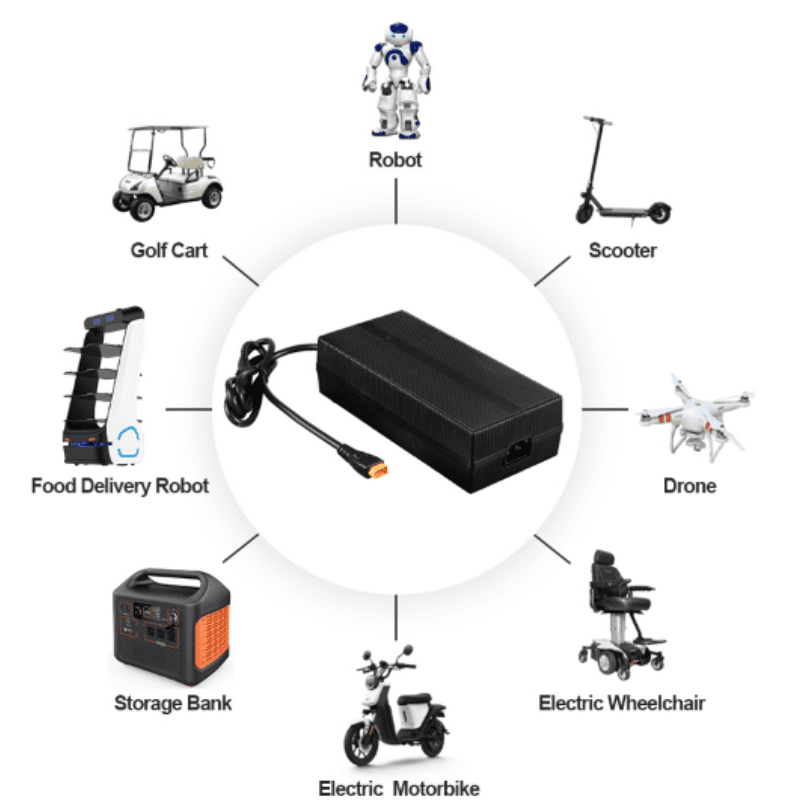
Integrated Charging Solutions
If you are looking for a company that can design and manufacture a complete custom smart charger system — covering solar input, and controlling of lithium battery, SLA battery, lead acid battery, Nimh battery. and the BESS integration, long-term OEM production — It requires a smart charger : Phonix is special designer and manufacturer , OEM & ODM with full electrical engineering and manufacturing capability.
Phonix develops integrated charging solutions for the renewable and battery-powered platforms. As a smart charger ODM & OEM charger factory, We does not only supply isolated charging modules but also we can designs coordinated charging architectures that align power conversion, firmware control, communication protocols, environmental protection, and scalable production.
Charging as a System, Not a Component
In industrial applications, charging cannot operate independently. It must align with battery chemistry, system load behavior, environmental conditions, and regulatory requirements. Integrated charging architecture means the following elements are engineered together rather than added separately:
- Photovoltaic MPPT regulation
- AC rectification and grid interaction
- Programmable lithium charging firmware
- BMS communication integration
- Thermal and environmental protection design
- Manufacturing consistency control
- AC to DC convert
These capabilities are developed within structured engineering workflows rather than assembled from third-party retail products.
Renewable and Hybrid Energy Coordination
Solar optimization logic follows the principles detailed in Industrial MPPT Charging Systems. Where hybrid AC and photovoltaic inputs coexist, control strategies align with Hybrid AC and Solar Charging Architecture.
In remote deployments without grid stability, charging behavior reflects the system discipline described in Custom Off-Grid Battery Charging Design.
Integrated architecture ensures these energy sources do not conflict but operate within a coordinated DC bus and firmware-managed priority structure.
Energy Storage and BESS Alignment
For battery energy storage platforms, charging systems must communicate with rack-level BMS units and comply with energy management frameworks. The system-level coordination described in Custom BESS Charging Integration forms part of the integrated design approach.
Voltage scaling, current sharing, and cabinet-level thermal management are defined during development rather than after deployment.
Programmable Lithium Control
Integrated solutions require firmware adaptability. Lithium charging parameters are not fixed; they are programmable according to chemistry, application profile, and safety thresholds. Control flexibility reflects the design principles outlined in Programmable Lithium Charging Systems.
This programmability ensures that charging behavior supports long-term battery life rather than short-term power delivery.
From Engineering Design to OEM Production
System integration loses value if production cannot maintain electrical and firmware stability. As an OEM charger factory, Phonix controls PCB layout consistency, firmware version traceability, thermal validation, and component sourcing stability.
Prototype performance and mass production performance must remain aligned. Integrated charging solutions therefore combine electrical engineering discipline with controlled manufacturing execution.
When Integrated Charging Becomes Necessary
Integrated charging architecture is typically required when:
- Solar, AC, and battery systems operate within the same platform
- Lithium packs require BMS communication control
- Environmental exposure exceeds consumer-grade limits
- Certification and compliance must align with regional standards
- Long-term OEM production is required
- Original IP with ODM for customer
In these cases, system-level engineering replaces modular assembly. Integrated charging design ensures electrical stability, battery longevity, and production continuity operate within a unified framework.
Charging performance is not defined by output current alone. It is defined by how well power conversion, firmware logic, environmental protection, and manufacturing control operate together. That is to say, the charger is not only charging,It is a complete system — in fact, it is the most critical part of the entire system.