
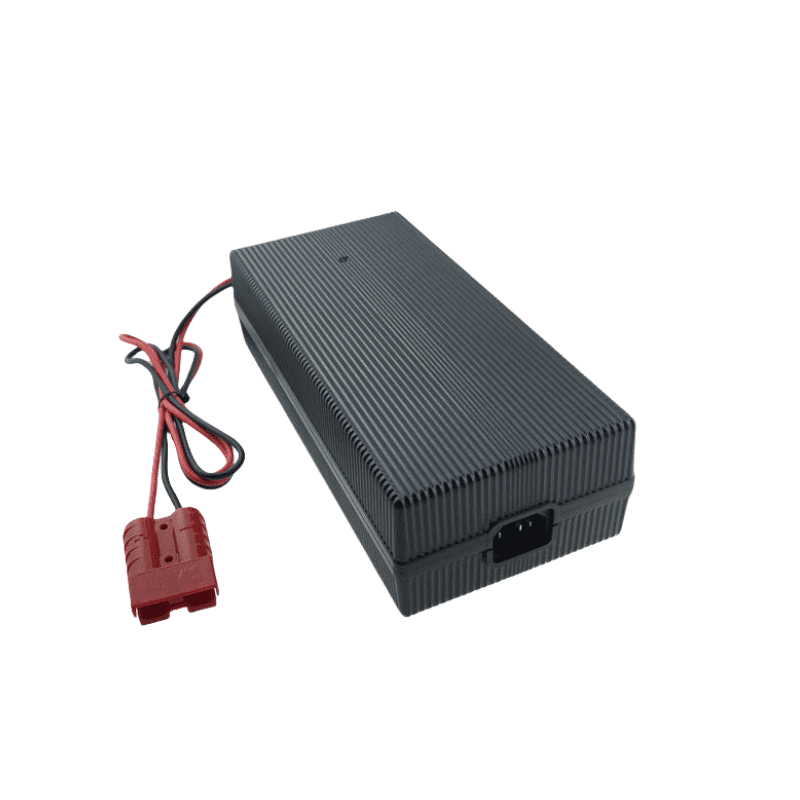
A smart lead-acid charger is designed to precisely control voltage, current, and charging stages based on battery condition, which is fundamentally different from conventional lead-acid chargers that rely on fixed output profiles. This article provides an engineering-level comparison to help system designers and industrial users understand the real technical differences.
1. Charging Logic: Fixed Output vs Adaptive Control
Conventional lead-acid chargers typically operate with a fixed voltage or simple current-limited design. While this approach can charge a battery, it does not adapt to battery aging, temperature variation, or load conditions.
In contrast, a lead-acid smart battery charger dynamically adjusts charging parameters based on real-time feedback. Voltage and current are regulated across multiple charging stages to reduce overcharge risk and extend battery cycle life.
2. Multi-Stage Charging Behavior
A smart lead-acid charger usually implements a multi-stage charging profile, including bulk, absorption, float, and optional equalization stages. Each stage serves a specific electrochemical purpose rather than simply pushing energy into the battery.
According to widely accepted charging principles for lead-acid batteries defined in international standards, accurate stage transitions are critical for preventing sulfation and thermal stress.
For reference, the general charging stages for lead-acid batteries are described in publicly available IEC documentation on battery charging methodologies.
3. Voltage and Power Range Flexibility
From an engineering perspective, smart lead-acid chargers are typically designed to support wide voltage and power ranges, such as 6V to 84V and from low-power maintenance charging up to several kilowatts for industrial systems.
This flexibility allows a single charging platform to be adapted for multiple battery configurations, reducing redesign effort for customized energy storage or industrial power equipment.
4. Protection and Diagnostic Capabilities
Another major difference lies in protection and diagnostics. A smart lead-acid charger integrates multiple protection mechanisms, including over-voltage, over-current, reverse polarity, and thermal protection.
More importantly, charging data can be logged and analyzed, enabling predictive maintenance and early fault detection in industrial applications.
5. Integration with Intelligent Systems
Unlike conventional chargers, smart chargers are often designed to integrate with higher-level systems. Communication interfaces and control logic allow interaction with battery management systems or external controllers.
This system-level integration is especially relevant for customized charging solutions used in energy storage systems, smart mobility platforms, and industrial power equipment.
Conclusion: When a Smart Lead-Acid Charger Is the Better Choice
A conventional charger may be sufficient for basic charging tasks, but for industrial and professional applications, a smart lead-acid charger offers measurable advantages in safety, battery longevity, and system reliability.
From an engineering standpoint, the decision is less about cost and more about lifecycle performance, protection depth, and system compatibility.
