
Can You Use a Lead-Acid Charger on a Lithium Battery?
If you’re upgrading from lead-acid to lithium batteries, and you are going to tempt to reuse your old charger. After all, both called “48V.” But in reality, using a lead-acid charger on a lithium battery is unsafe and can lead to overheating, battery damage, or even fire.
If you’re unsure which charger to use, it’s always safer to choose a professional battery charger manufacturer that understands lithium charging requirements.
Why Lead-Acid Chargers Damage Lithium Batteries
The biggest problem is voltage mismatch. “48V” is only a nominal label—the actual charging voltage is very different depending on battery chemistry.
- 48V Lithium-ion (13S): 54.6V full charge
- 48V LiFePO4 (16S): 58.4V full charge
- Lead-acid chargers: can reach 58V–60V+
Even a small over voltage can damage lithium cells. Exceeding safe voltage limits leads to internal stress, lithium plating, and long-term degradation.
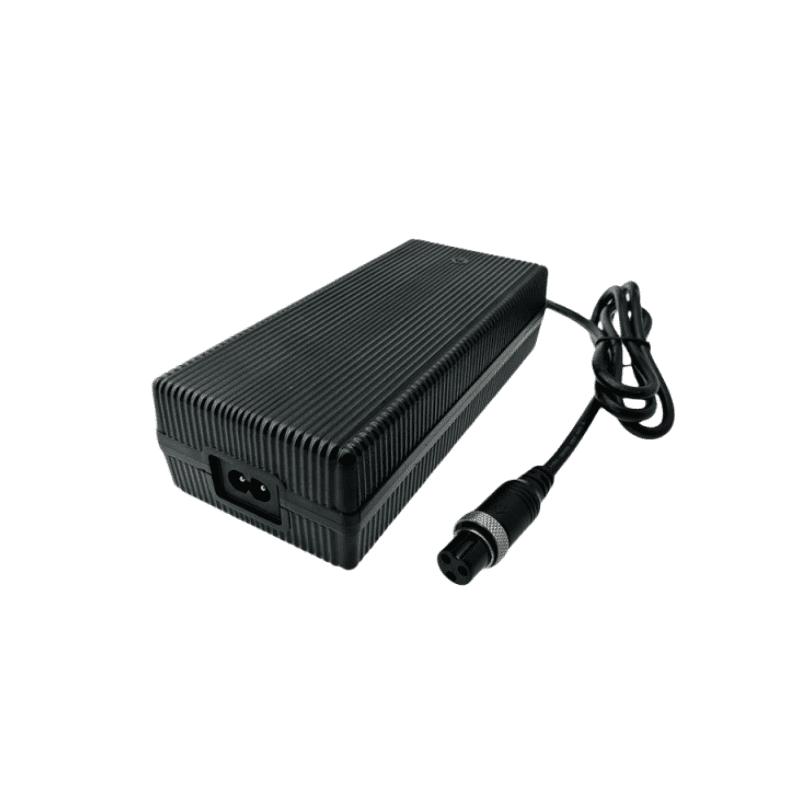
The Hidden Risk: Desulfation Mode
Many lead-acid chargers include a desulfation mode that sends high-voltage pulses into the battery.
- Pulse voltage can exceed 60V
- Can destroy the Battery Management System (BMS) – Too high voltage is very terrible destroy for BMS.
- Removes critical overcharge protection, high voltage can destroy the protection circuit
Once the BMS is damaged, the battery can no longer regulate voltage safely, increasing the risk of failure.
the Key difference – Charging Curve Mismatch (Critical Difference)
Lead-acid and lithium batteries follow completely different charging logic:
- Lead-acid: Bulk → Absorption → Float (continuous charging)
- Lithium: Constant Current → Constant Voltage (CC/CV), then stop
Lithium batteries require precise voltage control and must stop charging at full capacity. Continuous trickle charging can cause overheating and chemical instability.
Charger mismatch is one of the most critical safety risks in lithium battery systems.
Using an incompatible charger can lead to overvoltage, BMS failure, and in extreme cases, fire or thermal runaway.
Battery safety organizations warn against using incompatible chargers. The U.S. Consumer Product Safety Commission (CPSC) recommends using only the correct charger designed for your battery.
Using the wrong charger can lead to overheating, fire, or even thermal runaway—a chain reaction that is difficult to stop. :contentReference[oaicite:2]{index=2}
Technical Data You Should Know
- 48V Lithium-ion (13S): 54.6V
- 48V LiFePO4 (16S): 58.4V
- Recommended charge current: 0.2C – 0.5C
- Max cell voltage: 4.2V (Li-ion), 3.65V (LiFePO4)
What Charger Should You Use?
Always use a charger specifically designed for your battery type and voltage.
For standard lithium-ion packs, a 54.6V charger for 48V lithium battery ensures correct voltage cutoff and safe CC/CV charging.
If your application requires special specifications, such as industrial systems or OEM solutions, consider a custom battery charger solution to match your exact battery parameters.
FAQ
Can I use a lead-acid charger just once?
No. Even one charge cycle can damage lithium cells or the BMS.
Why do both say 48V?
“48V” is nominal voltage. Actual charging voltage differs by chemistry.
Will the BMS protect the battery?
Only partially. High voltage spikes can still damage the BMS itself.
What happens if lithium battery is overcharged?
It can cause overheating, swelling, internal short circuits, or fire.
Using a lead-acid charger on a lithium battery is unsafe due to voltage mismatch, incompatible charging profiles, and the risk of BMS failure.
To protect your battery and ensure safety, always use a lithium-specific charger designed for your exact voltage and chemistry.
At Phonix Charger, safety and reliability are always our top priorities. Every charger is designed to match the exact voltage and charging profile required by lithium batteries.
