
When smartwatches first entered the market, they were often seen as step counters or notification helpers. But that era is long gone. Today, they serve as 24/7 personal health monitors—tracking sleep structure, HRV, heart rate, oxygen saturation, stress response, training load, and daily recovery.
According to IDC, the global wearable device market grew 10.5% in Q1 2025, and China alone saw an impressive 37.6% surge. This growth reflects a shift: wearable devices have become a key interface between individuals and their personal health.
Yet there is a critical element that often goes unnoticed:
How the device is charged affects both its data accuracy and its long-term lifespan.
This is where smart chargers come into play—not simply as power suppliers, but as energy managers.
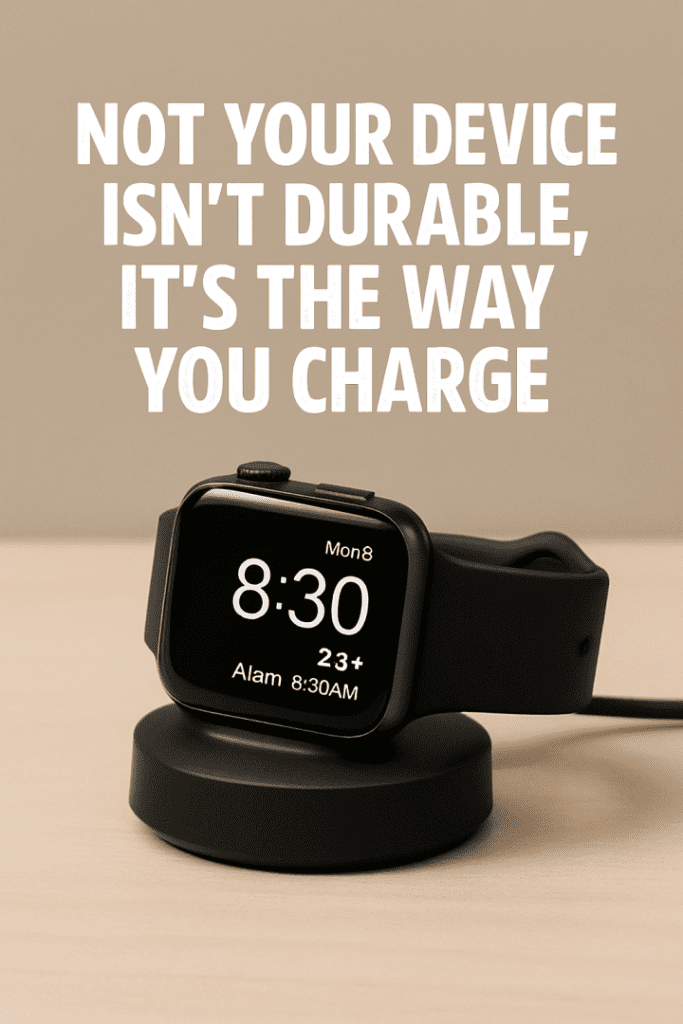
1. Why Smart Chargers Matter More Than Ever
Traditional chargers were built on one idea: charge as fast as possible.
But lithium batteries inside smartwatches behave differently from phone batteries. Keeping a small battery at high voltage (>80%) for extended periods accelerates aging. So does charging in a high-temperature environment.
This means:
- Fast charging isn’t always good.
- Charging overnight at full power can reduce battery capacity.
- Battery wear reduces both runtime and sensor accuracy.
Smart chargers solve this by adjusting power delivery based on battery state:
| Battery Level | Best Charging Strategy | Purpose |
|---|---|---|
| 0%–60% | Higher power, fast recovery | Efficiency |
| 60%–80% | Gradual power reduction | Cell protection |
| 80%–100% | Trickle charge or scheduled top-up | Avoid high-voltage stress |
In short: a smart charger doesn’t just “fill the battery” — it protects it.
2. Heat Control Directly Affects Sensor Accuracy
Inside a smartwatch are sensitive components:
- Optical heart-rate array
- Skin temperature sensor
- ECG electrodes
- Pressure and motion sensors
Charging generates heat. Excess heat can distort sensor calibration, leading to inaccurate readings — especially during overnight sleep tracking, continuous HRV monitoring, or blood-oxygen monitoring.
Therefore, high-quality smart chargers integrate:
- NTC temperature monitoring
- Active heat-protection algorithms
- Intelligent power throttling
Not for safety alone — but for data accuracy.
3. Multi-Device Charging: Power Allocation Matters
Most users now own more than one wearable: smartwatches, fitness trackers, TWS earbuds, and sometimes health patches. Each requires different power levels, voltages and protocols.
Advanced smart chargers therefore provide:
- Adaptive voltage negotiation (5V / 9V / 12V)
- Real-time power distribution
- Low-power mode for small batteries
The goal is not charging speed, but charging suitability — ensuring each device receives the right level of energy.
4. Practical Example: Behavior-Based Charging
For example, some smart charging systems learn user routines and adapt charging accordingly. A wearable charging dock might:
- Charge to ~80% and pause before long rest periods
- Resume at low voltage shortly before the user typically wakes
This keeps the battery away from long-duration high-voltage stress, which is a major driver of lithium aging. Such strategies align with system-level battery optimizations used by leading device makers.
If you’d like to review a technical application case, visit Phonix Charger for examples of behavior-based charging for wearable devices.
5. The Future: Chargers Must Adapt to New Battery Chemistry
Emerging silicon-anode and semi-solid-state batteries promise faster charging and higher energy density, but they are often more sensitive to overheating. For an in-depth look at next-generation battery materials, see IDTechEx.
This evolution means chargers must be algorithmically upgradeable so they can adapt as battery chemistries and charging profiles change.
Conclusion
Choosing the right smart charger is not accessory shopping. It’s a decision that affects:
- How accurate your health data is
- How long your smartwatch remains reliable
- Whether your device battery can realistically last 2–3 years or longer
A smart charger understands your device, protects your sensors, extends your battery lifespan, and supports your long-term health tracking.
If you’d like detailed technical cases and device compatibility notes, you can review application examples at Phonix Charger.
