
Why 54.6V Is Not Enough for 48V Lead-Acid Batteries (57V–59V Explained)?
If you’ve spent any time working on e-bikes, golf carts, or off-grid systems, you’ve probably seen 54.6V labeled as a “standard” charger for 48V batteries. That’s true for lithium—but not for lead-acid.
A 54.6V charger is not suitable for 48V lead-acid batteries because it cannot reach the required absorption voltage of 57V–59V needed to prevent sulfation.
This is not a small mismatch. Using an incorrect charger voltage can silently reduce battery capacity, shorten lifespan, and eventually lead to complete failure.
For example, a properly designed 54.6V charger for 48V lithium battery is specifically built for 13S lithium-ion systems—but that same charger is fundamentally incompatible with lead-acid chemistry.
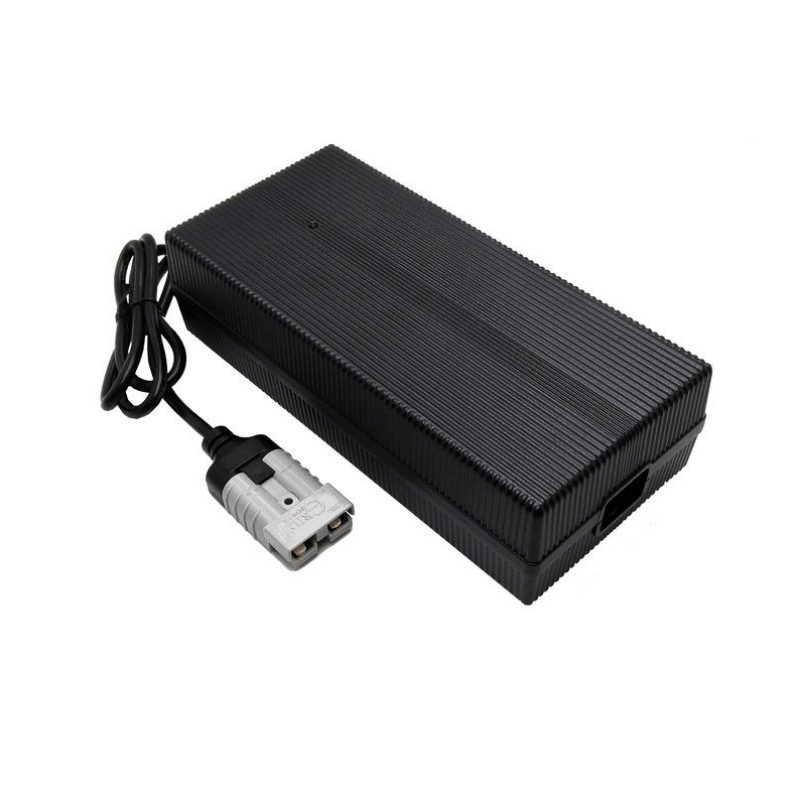
The “48V” Label Doesn’t Mean What You Think
A “48V battery” is a nominal rating, not an actual working voltage.
In a lead-acid system, 48V typically means four 12V batteries connected in series. A fully charged 12V lead-acid battery rests at around 12.6V–12.8V. That means your “48V” system is already above 51V before charging begins.
To push energy back into the battery, the charger must provide a higher voltage—otherwise, the chemical reaction cannot fully reverse.
Why 54.6V Falls Short for Lead-Acid Batteries
The 54.6V voltage comes from lithium-ion battery design:
- 4.2V per cell × 13 cells (13S) = 54.6V
This works perfectly for lithium-ion batteries, which charge quickly and stop once they reach this voltage.
Lead-acid batteries behave very differently. They require a higher voltage during the critical absorption phase—typically around 57.6V to 58.8V—to fully convert lead sulfate back into active material.
If you only charge to 54.6V, the battery may appear “almost full,” but the internal chemistry remains incomplete.
Real-World Impact: Undercharging vs Proper Charging
Consider two typical users running 48V lead-acid systems:
- User A (Using 54.6V charger): The battery never reaches absorption voltage. Over time, capacity drops significantly, often below 50% of its rated value.
- User B (Using 58.4V charger): The battery completes full charge cycles, maintaining performance and lifespan over years.
The difference is not subtle—it directly determines whether your battery investment lasts months or years.
Sulfation: The Hidden Cause of Battery Failure
When a lead-acid battery discharges, sulfate crystals form on the plates. This is normal.
However, if the battery is not fully recharged at the correct voltage:
- The crystals do not dissolve
- They harden over time
- They permanently reduce capacity
This process is known as sulfation, and it is the primary reason lead-acid batteries fail prematurely.
A 54.6V charger cannot reach the voltage required to reverse this process.
Charging Voltage Comparison
| Battery Type | Nominal Voltage | Full Charge Voltage |
|---|---|---|
| Lithium-ion (13S) | 48V | 54.6V |
| LiFePO4 (16S) | 48V | 58.4V |
| Lead-acid | 48V | 57V–59V |
The Three Charging Stages (Why Voltage Matters)
A proper lead-acid charger follows three stages:
- Bulk: Rapid charging until voltage reaches ~57V
- Absorption: Holds 57.6V–58.8V to complete chemical conversion
- Float: Maintains ~54V to keep battery full
Interestingly, a 54.6V charger operates close to float voltage. It can maintain a battery, but it cannot fully charge it.
Common Mistake: Assuming All 48V Chargers Are the Same
One of the most common mistakes is choosing a charger based only on the “48V” label.
The key rule is simple:
Charger voltage must match the battery’s full charge voltage, not its nominal voltage.
Choosing the Right Charger
Using the correct charger is essential for both safety and performance.
For lithium-ion systems, a dedicated 54.6V lithium battery charger ensures accurate voltage control and built-in protection features.
For lead-acid batteries, always use a charger capable of reaching the proper absorption voltage (57V–59V).
Final Choice advice
A 54.6V charger works perfectly for 48V lithium-ion (13S) batteries, but it is not suitable for lead-acid systems.
Using the wrong charger may seem harmless at first, but over time it leads to sulfation, reduced capacity, and early battery failure.
Choosing a charger matched to your battery chemistry is the simplest way to protect performance, extend lifespan, and avoid unnecessary replacement costs.
